
Video Surveillance
Video surveillance serves as the remote eyes for management and the security force. It provides security personnel with advance notice of breaches in security, including hostile and terrorist acts, and is a part of the plan to protect personnel and assets. It is a critical subsystem for any comprehensive security plan.
Common uses of video surveillance include observing the public at the entry to sports events, public transportation (train platforms, airports, etc.), and around the perimeter of secure facilities, especially those that are directly bounded by community spaces.
Video Surveillance System Elements

Artificial Intelligence
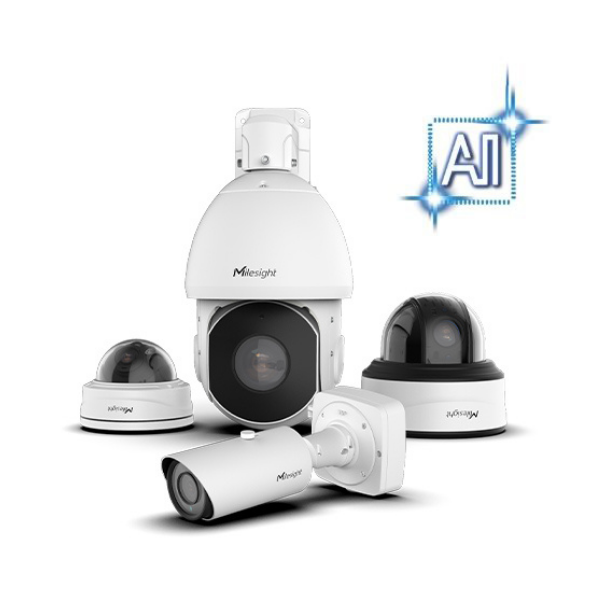
Artificial intelligence for video surveillance utilizes computer software programs that analyze the audio and images from video surveillance cameras in order to recognize humans, vehicles, objects, attributes, and events.
The A.I. program functions by using series of algorithms, or mathematical procedures, which work like a flow-chart or series of questions to compare the object seen with hundreds of thousands of stored reference images of humans in different postures, angles, positions and movements.
Automatic Number-Plate Recognition
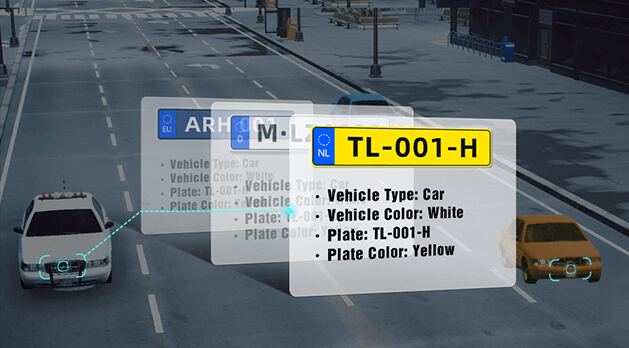
Automatic number-plate recognition is a technology that uses optical character recognition on images to read vehicle registration plates to create vehicle location data. It uses cameras specifically designed for the task. ANPR is used by police forces around the world for law enforcement purposes, including to check if a vehicle is registered or licensed. It is also used for electronic toll collection on pay-per-use roads and as a method of cataloguing the movements of traffic, for example by highways agencies.
ANPR Algorithms
Facial Recognition
Facial recognition typically refers to systems which collect and process data about a person’s face. These systems are highly intrusive because they rely on the capture, extraction, storage or sharing of people’s biometric facial data -often in absence of explicit consent or prior notice.
Face-detection algorithms focus on the detection of frontal human faces. It is analogous to image detection in which the image of a person is matched bit by bit. Image matches with the image stores in database.
Firstly, the possible human eye regions are detected by testing all the valley regions in the gray-level image. Then the genetic algorithm is used to generate all the possible face regions which include the eyebrows, the iris, the nostril and the mouth corners.